
Beyond the Badge: Why Standard Guard Cards Fall Short in Healthcare Environments
For hospital administrators, safeguarding a medical facility presents a distinct set of operational challenges. Unlike a traditional corporate building or retail space, a hospital never closes, operates under constant emotional strain, and forces security personnel to interface with a uniquely vulnerable population.
When an incident occurs in an emergency department or a psychiatric wing, relying on standard “Guard Card” training is a liability. To mitigate risk, protect staff, and maintain regulatory compliance, healthcare facilities require specialized Orange County Hospital Security Training built specifically for the chaos of the healthcare frontlines.
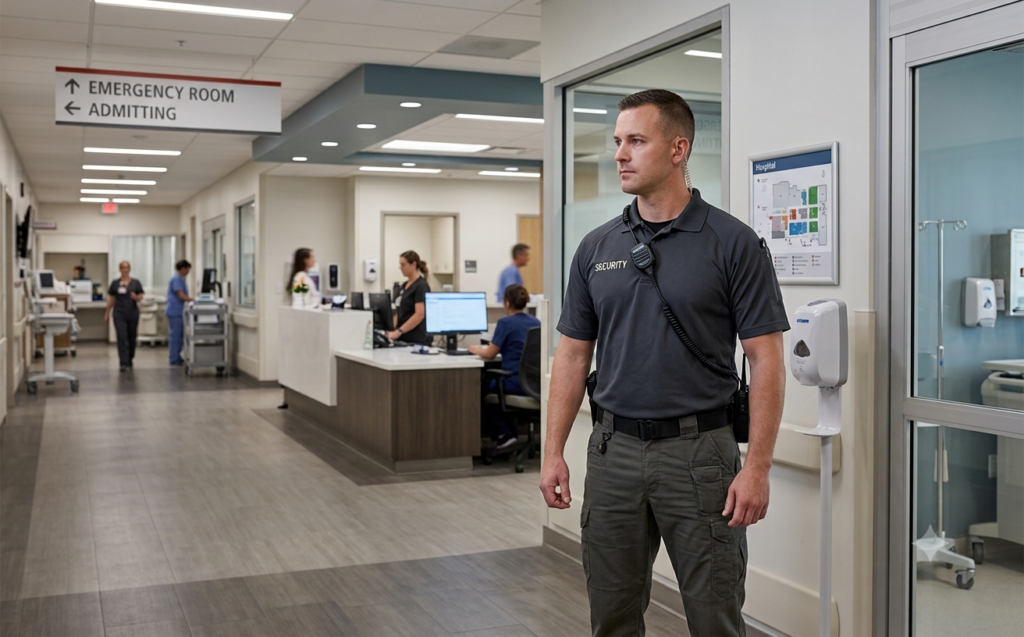
At Mana Group Training Solutions and Mana Group Private Security and Consulting, we look at security through a dual lens. With more than two decades of professional experience spanning both high-level private security and active emergency medical services (EMS), we understand exactly where standard security protocols break down in a clinical environment.
Here is why healthcare security requires a specialized tier of training, and how we prepare guards to protect your hospital.
The Crucial Differences in Healthcare Security Training
Standard security training prepares a guard to observe, report, and secure perimeters. It does not prepare them for a chaotic triage room or an escalating patient crisis. A comprehensive healthcare security curriculum must bridge the gap between physical protection and clinical awareness by mastering five distinct pillars:
1. Advanced Verbal De-Escalation
In a hospital setting, the vast majority of security incidents stem from grief, fear, cognitive impairment, or substance use. Physical intervention should always be the absolute last resort. Guards must be explicitly trained in verbal de-escalation strategies tailored for medical settings. They must learn how to defuse highly emotional family members and agitated patients before a situation turns physical.
2. Managing Extreme Stress & High-Velocity Environments
Hospitals operate at a baseline of high adrenaline. When an active threat, a combative patient, or a massive trauma influx occurs, cortisol spikes. Security personnel must possess the psychological conditioning to regulate their own stress response. Training must include stress-inoculation drills so guards can make logical, legally sound decisions under extreme duress.
3. Navigating Compressed and Confined Spaces
Standard defensive tactics often rely on open space to create distance. In a hospital, altercations routinely happen in tight patient rooms, narrow corridors, bathrooms, or behind privacy curtains. Guards need specialized training in close-quarters. This requires control tactics that protect the individual without damaging sensitive, life-saving medical equipment or interrupting active patient care.
4. Mental Illness and Behavioral Health Response
Security personnel are frequently called to assist with behavioral health holds (such as 5150 scenarios in California) or patients experiencing acute psychosis. Understanding the nuances of mental illness changes the entire approach to a restraint or containment situation. Guards must learn how to seamlessly support clinical staff. At the same time ensuring patient dignity and safety while maintaining physical control of the environment.
5. Biohazards & Bloodborne Pathogens
A physical struggle in a hospital introduces immediate exposure risks. Unlike a standard commercial post, a hospital guard is likely to encounter bodily fluids, sharps, and airborne or bloodborne pathogens. Training must cover these special aspects of the environment to keep the guard and others safe.
Real-Time Confidence Built for Orange County Healthcare Facilities
The objective of advanced training isn’t just to check a compliance box. It is to cultivate a level of competence that translates directly into real-time applications. When security guards understand the intersection of physical defense and medical realities, they can prevent minor incidents from escalating.
The Mana Group understands the rigorous scheduling demands of modern healthcare facilities. That’s why lead instructor Tony offers this comprehensive hospital security curriculum in a dedicated 24-hour training program. Designed to maximize retention, this 24-hour course can be delivered in 2-day or 3-day blocks directly tailored to your shifts.
Elevate Your Facility’s Security Standard
Hospitals are sanctuaries of healing, but they are also unpredictable environments. Elevating your on-site security guard training protects your nurses, insulates your administration from liability, and preserves the integrity of your patient care.
Ensure your team has the edge that only twenty years of security and EMS experience can provide.
Contact Mana Group today to schedule an Orange County Hospital Security Training consultation for your facility.
Call Big Tony at (714) 925-2448
bigtony@mana-group.com